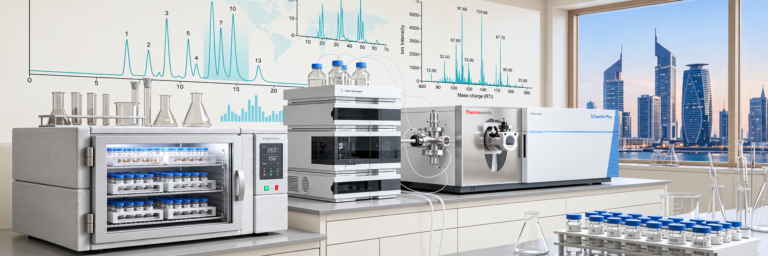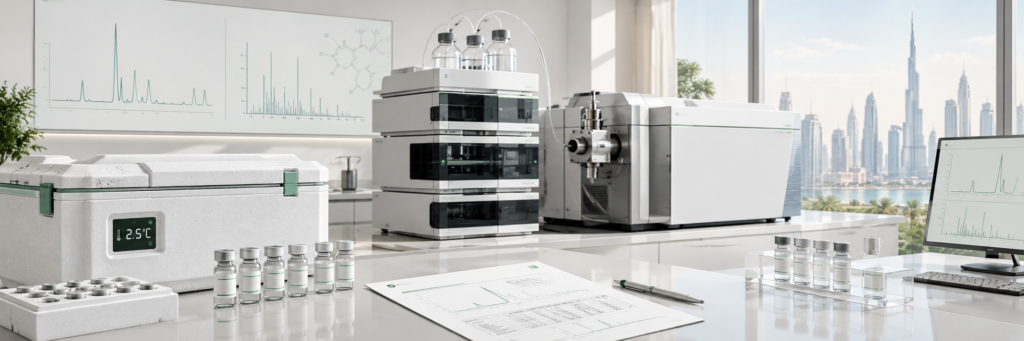
Securing premium research materials within the UAE brings distinct hurdles. Buyers face a combination of strict import laws, the danger of forged lab reports, and the harsh realities of extreme summer heat. For scientists, purchasing managers, and educated consumers in the Emirates, confirming the exact chemical makeup and purity of a substance is the bedrock of any legitimate scientific endeavor.
Marketing buzzwords like “99% pure” carry zero weight unless backed by specific, batch-matched analytical proof. Moreover, the most pristine compound will quickly degrade if it is left to bake in an unconditioned Dubai customs facility. This article explores how to properly assess peptide quality, interpret laboratory certificates, and choose regional distributors capable of delivering fully potent materials.
Understanding High-Performance Liquid Chromatography (HPLC)
To ensure ultimate reliability, research chemicals must undergo strict chemical purity analysis via high-performance liquid chromatography (HPLC). This technique isolates the individual chemical elements within a sample to determine exact purity ratios. This ensures the material hits the rigorous 99% purity benchmark necessary for complex laboratory work before it ever reaches a local buyer.
HPLC works by forcing a pressurized solvent, which holds the sample through a specialized column packed with adsorbent material. Since different molecules react uniquely to this material, they exit the column at varying speeds, referred to as their retention time.
As these isolated parts emerge, a sensor graphs them onto a chromatogram. On this visual report, individual chemicals show up as distinct peaks. The largest peak signifies the desired peptide, while any minor peaks point to contaminants. These unwanted elements might be incomplete sequences, missing amino acids, or leftover chemicals from the manufacturing process. By comparing the area of the main peak against the combined area of all peaks, technicians can calculate the precise purity percentage. For serious research, reaching a 98% to 99% threshold is an absolute requirement.
Why Mass Spectrometry is a Mandatory Companion Test
While locating a vendor that utilizes HPLC is a great first step, this test alone does not paint the whole picture of a product’s quality. HPLC is perfect for quantifying how much of a primary substance exists in a container, but it falls short of confirming the actual identity of that substance.
If a manufacturer flawlessly creates the incorrect amino acid chain, an HPLC graph might still display a brilliant 99% purity peak. The problem is that your container holds 99% of the wrong material. Because of this blind spot, Liquid Chromatography-Mass Spectrometry (LC-MS) is indispensable.
Mass spectrometry evaluates the precise mass-to-charge ratio of the sample’s molecules. Every single peptide has a known, theoretical molecular weight dictated by its specific amino acid makeup. By cross-referencing the actual molecular weight found in the LC-MS analysis with the expected theoretical weight, you can definitively prove the compound is exactly what the label says it is. A credible supplier will never hesitate to supply both sets of analytical data.
Identifying Fraudulent Lab Reports in the GCC
As the local GCC market for research materials expands, so does the circulation of falsified lab documents. Both international and regional grey-market operators often use misleading strategies to sell subpar goods. Identifying these warning signs is crucial for safeguarding your experiments:
- Recycled Documents: A seller might test a single, highly pure batch and reuse that identical report for years across entirely different manufacturing runs. Always scrutinize the testing date; documents older than a few months rarely represent the actual product being shipped.
- Absent Batch Traceability: If the actual vial in your hands lacks a printed batch code that perfectly mirrors the one on the lab report, the provided data is completely meaningless. Leading facilities maintain rigorous batch tracking, often deploying specialized thermal labels, ensuring smudge-proof and permanent batch identification.
- Low-Quality Visuals: Authentic lab results contain crisp, high-resolution graphs with clearly defined X and Y axes. If the chromatogram resembles a pixelated screenshot or obscures important figures, it has likely been doctored.
- Lack of Independent Verification: While internal quality checks are good practice, top-tier vendors utilize independent, third-party analytical labs to audit their inventory. Reports created entirely by the vendor without an external lab’s letterhead should be treated with extreme caution.
A Step-by-Step Guide to Validating Analytical Certificates
A true Certificate of Analysis acts as the official record for both purity and identity testing. Use this practical workflow to validate any lab report before introducing a new compound to your workspace:
- Confirm the Tracking Code: The most essential validation step is cross-referencing the batch sequence. A valid document must feature a distinct batch number, and that exact alphanumeric string must appear on the physical item you unpack.
- Check the Timeline and Facility: Ensure the testing date makes logical sense relative to when you placed the order. Furthermore, look up the independent testing facility’s contact details to confirm they are a legitimate, operational business.
- Analyze the Raw Metrics: An unaltered report will showcase complete chromatograms. The purity graph needs sharp, standalone peaks with axes that clearly map out absorbance and retention time. Additionally, the document must display both the expected molecular weight and the actual measured weight from the mass spectrometry run.
Bypassing Customs Delays and the Regional Heat Factor
Beyond analyzing paperwork, procuring sensitive materials in the Middle East involves battling a harsh environmental obstacle: the climate. Summer temperatures across Dubai, Abu Dhabi, Sharjah, and neighboring regions easily push past 40°C. Because peptides are fragile biological structures, sustained exposure to intense heat rapidly destroys their molecular bonds, leaving the material completely useless.
When importing directly from overseas, shipments must navigate local customs borders. Under current regulations—specifically the MOHAP-regulated Federal Law No. 38 of 2024—chemical imports are heavily scrutinized. Direct overseas purchases are often stopped, resulting in massive delays, paperwork demands, or confiscation by inspectors.
If a package sits in a sweltering, un-air-conditioned holding area for weeks awaiting clearance, the delicate compounds inside will be ruined. A vial verified at 99% purity upon leaving a foreign laboratory could be heavily degraded by the time it reaches your desk, totally compromising your research outcomes.
This logistical roadblock highlights exactly why partnering with a regionally based distributor is paramount. By maintaining a localized, tested inventory, domestic suppliers absorb the burden of customs clearance, protecting the end-user from delays.
Assessing Regional Distributors for Operational Excellence
When choosing a provider, purchasing teams must identify a partner that pairs strict scientific testing with flawless regional logistics. Here are the key indicators of a high-end local distributor:
- Temperature-Controlled Transit: With an unforgiving climate, the method of delivery is everything. Trusted regional providers leverage cold-chain packaging, shipping orders in insulated containers with refrigerants to keep the environment stable during movement. Partnering with specialized logistics networks guarantees that shipments are held within strict +2°C to +10°C parameters, preserving compound integrity from dispatch to your laboratory door.
- Accelerated Domestic Shipping: Relying on a local source means waiting hours instead of weeks for materials to arrive. A competent distributor in the Emirates should provide same-day or next-day turnaround via climate-controlled couriers. This urgency drastically limits the product’s exposure to ambient temperatures, locking in the purity verified by the lab reports.
- Secure Transactions and Buyer Support: Dealing with international bank wires or crypto transfers for foreign orders can be risky and confusing. Instead, seek out storefronts connected to robust regional payment gateways to guarantee commercial security. Furthermore, vendors that offer Cash on Delivery (COD) show high confidence in their operations, giving buyers the chance to physically inspect the parcel before handing over any money.
Validating the integrity of research chemicals in the Middle East demands a sharp eye for both analytical data and logistical realities. Securing dependable supplies means demanding batch-matched paperwork, insisting on dual purity and identity testing, and verifying that the vendor possesses the cold-chain capabilities to survive the desert climate. By focusing on logistical transparency and domestic fulfillment, scientists can bypass regulatory hurdles and guarantee their work relies entirely on pristine, verified compounds.
Ready to elevate your next project with rigorously tested materials? Explore the catalog at Re-Gen Labs for premium research compounds, complete with transparent batch data and specialized, temperature-controlled delivery throughout the Emirates.
Disclaimer: The products discussed are intended exclusively for in-vitro laboratory research and analytical use. They are strictly prohibited for human consumption, therapeutic application, or clinical diagnostics.
Academic & Regulatory References
- UAE Ministry of Health and Prevention (MOHAP): Good Distribution Practice (GDP) Guidelines for Pharmaceutical and Cold Chain Logistics.
- Liquid Chromatography – Mass Spectrometry: An Introduction (Robert E. Ardrey): Methodologies for confirming exact molecular weight, interpreting mass-to-charge ratios, and verifying chemical identity.
- Kumar, N., & Jha, A. (2017). Temperature excursion management: A novel approach of quality system in pharmaceutical industry. Saudi Pharmaceutical Journal, 25(2), 176–183.
- Warner, C. J. A., et al. (2017). A Tailored HPLC Purification Protocol That Yields High-purity Peptides. Journal of Visualized Experiments, (125), 55482.
- Evers, A., et al. (2022). Long-Term Stability Prediction for Developability Assessment of Biopharmaceutics Using Advanced Kinetic Modeling. Pharmaceutics, 14(2), 375.
- Reversed-phase HPLC for peptide purity— PubMed
- Mass spectrometry for peptide identity confirmation — PubMed
- Principles and Applications of Liquid Chromatography-Mass Spectrometry in Clinical Biochemistry – PubMed
- Janoshik Analytical — the laboratory that issues our certificates